
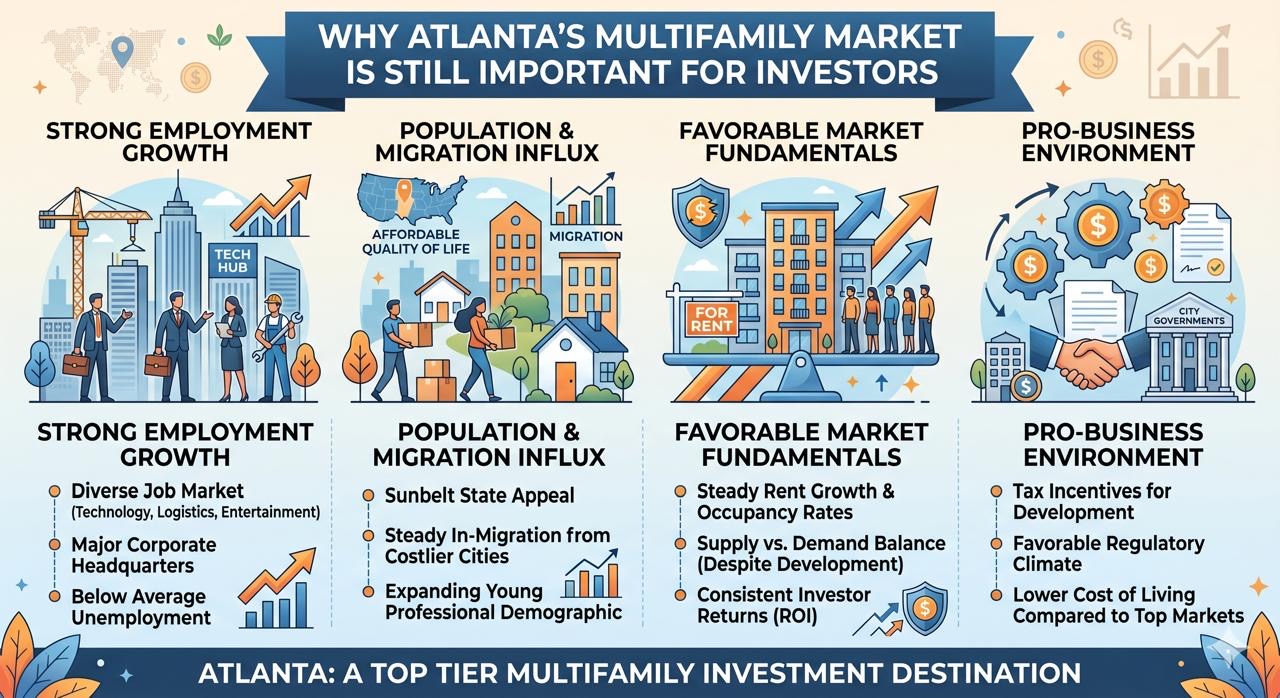
Atlanta has long been one of the most closely watched real estate markets in the Southeast, and for good reason. Even as interest rates, construction costs, and economic uncertainty continue to shape investment decisions nationwide, Atlanta’s multifamily market remains one of the most important sectors for investors to watch. From steady population growth and a diversified job base to long-term rental demand and value-add opportunities, Atlanta continues to offer a compelling case for multifamily investment.
For both local and out-of-state buyers, the question is no longer whether Atlanta matters—it’s why Atlanta’s multifamily market still deserves a place in an investor’s strategy.
Atlanta’s Population Growth Continues to Support Rental Housing Demand
One of the biggest reasons Atlanta’s multifamily market remains important is the metro’s ability to attract new residents year after year. Atlanta continues to benefit from migration trends that favor Sun Belt cities with strong job creation, relative affordability, and a high quality of life.
As more people move to the Atlanta metro for employment, education, and lifestyle reasons, the need for rental housing stays strong. Not every new resident is ready to buy a home right away. Many prefer the flexibility of renting, especially young professionals, relocating families, students, and workers who are new to the area. This creates a deep renter pool that helps support apartment occupancy across a wide range of submarkets.
For investors, population growth is more than a headline—it’s a demand driver that can support occupancy, leasing activity, and long-term property performance.
Multifamily Offers a More Resilient Investment Model
Compared with many other asset types, multifamily properties tend to provide a more stable investment structure. Office and retail sectors have faced major changes over the past several years, but housing remains a basic need. Even in shifting market conditions, people still need a place to live, and well-located multifamily properties are often positioned to benefit from that reality.
Atlanta’s multifamily sector is especially important because it combines the defensive qualities of housing with the upside of a high-growth metro. A multifamily asset doesn’t rely on a single tenant the way a single-family rental or commercial building might. Instead, income is spread across multiple units, which can help reduce risk and create more consistent cash flow.
For investors focused on long-term wealth building, this makes multifamily a practical option for balancing income, appreciation potential, and portfolio stability.
Atlanta’s Job Base Creates Long-Term Housing Demand
A healthy multifamily market depends heavily on employment, and Atlanta continues to stand out as one of the Southeast’s strongest economic hubs. The metro has a broad employment base that includes logistics, healthcare, film and entertainment, finance, education, technology, and professional services.
This economic diversity matters because it helps Atlanta avoid overreliance on a single industry. When a city creates jobs across multiple sectors, it supports a broader renter base and reduces the risk that demand will collapse if one part of the economy slows down.
For multifamily investors, that means Atlanta is not just a “hot market” driven by hype. It is a market with real economic fundamentals behind it—something that becomes even more valuable during uncertain periods in the broader economy.
Homeownership Challenges Continue to Benefit Rentals
Affordability remains a major issue in many U.S. housing markets, and Atlanta is no exception. Higher mortgage rates, rising home prices, larger down payment requirements, and tighter lending standards have made homeownership more difficult for many households.
That dynamic continues to push renters toward apartments and other multifamily housing options. Some residents are renting longer by choice, while others are renting because buying is temporarily out of reach. Either way, this trend helps sustain demand for professionally managed multifamily properties throughout the metro.
For investors, this is one of the key reasons Atlanta multifamily still matters. When homeownership becomes harder to access, rental demand often becomes more durable—and durable demand is exactly what supports occupancy and revenue over time.
Atlanta Still Offers a Wide Range of Multifamily Investment Opportunities
Another reason Atlanta’s multifamily market remains important is the variety of opportunities it offers. Investors are not limited to one strategy or one type of renter profile. Across the metro, there are opportunities in:
- Core urban submarkets with strong walkability and job access
- Suburban communities with family-oriented renter demand
- Value-add apartment properties that can benefit from renovations and operational improvements
- Newer Class A assets in high-growth corridors
- Workforce housing that serves a large and consistent tenant base
This flexibility makes Atlanta attractive to a wide range of investors, from first-time buyers and syndicators to private equity groups and long-term hold investors. Some buyers are targeting cash-flowing suburban assets. Others are looking for repositioning opportunities in older communities with upside potential. The market is broad enough to support multiple approaches.
Multifamily Demand Is Tied to Lifestyle and Demographic Trends
Atlanta’s multifamily story is not only about economics—it’s also about lifestyle. Renters today want flexibility, convenience, and access to employment centers, dining, retail, and transportation. Multifamily communities that offer these benefits continue to attract attention from a broad range of tenants.
Younger renters may prioritize location and amenities. Families may look for larger units in suburban school districts. Empty nesters and downsizers may choose apartment living to reduce maintenance responsibilities. This wide renter base gives Atlanta’s multifamily market depth and staying power.
For investors, the takeaway is simple: Atlanta is not dependent on one narrow demographic trend. It has multiple renter groups that support multifamily demand in different neighborhoods and at different price points.
Why Investors Should Keep Watching Atlanta Multifamily
No market is perfect, and Atlanta is not immune to challenges such as supply cycles, financing costs, insurance increases, or shifting rent growth. But those short-term pressures do not change the bigger picture. Atlanta remains a large, growing, economically diverse metro with strong rental demand and a deep multifamily ecosystem.
That is why multifamily continues to matter here. Investors are not just buying apartment buildings—they are investing in a market with long-term population growth, employment expansion, and ongoing housing demand. In a real estate environment where fundamentals matter more than ever, Atlanta’s multifamily sector continues to stand out.
For investors seeking stable income, long-term demand, and strategic growth potential, Atlanta’s multifamily market remains highly relevant. Whether you are considering a small apartment acquisition, a value-add repositioning, or a larger portfolio strategy, Atlanta still offers many of the ingredients investors look for in a strong rental market.
The market may evolve, but its importance has not gone away. If anything, Atlanta’s combination of growth, renter demand, and investment flexibility is exactly why multifamily remains one of the most important sectors for investors today.